Synapex — Business Analysis & Data Analytics · Verify MBCS
01 — Define the Business Problem
← Selected Subprocesses · Power BI Framework Overview
Purpose
This subprocess demonstrates how an analytics initiative begins by establishing a clear and evidence-based understanding of the business problem before requirements, data or solution design activities begin.
The objective is to understand why change is required, who is affected and what business outcomes need to be achieved without prematurely defining the technical solution.
Process Diagram
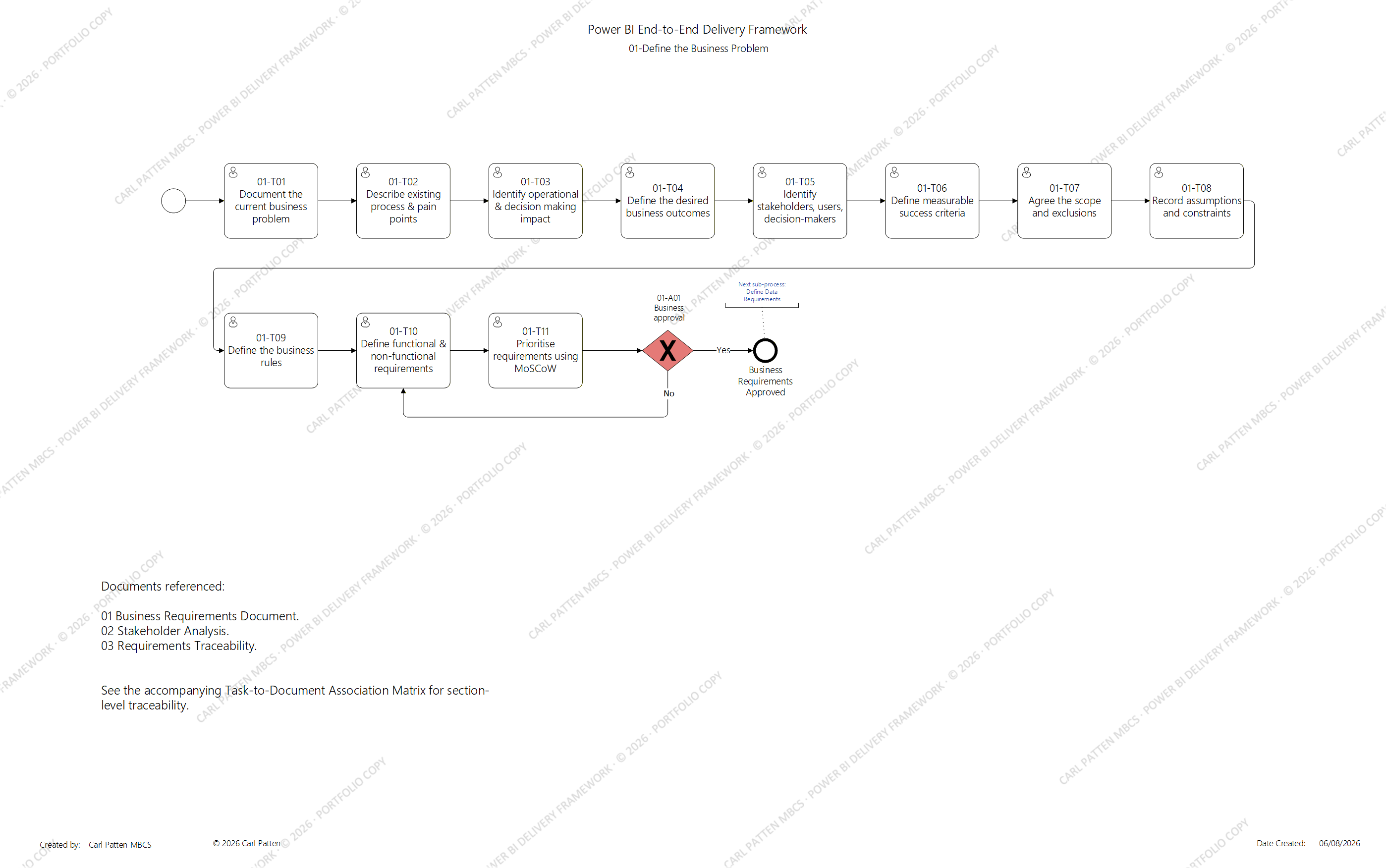
01 — Define the Business Problem. Selected subprocess from the Power BI End-to-End Delivery Framework. © 2026 Carl Patten. Portfolio copy.
The editable process model is retained privately.
What This Demonstrates
This subprocess provides evidence of:
- structured business-problem analysis;
- current-state investigation;
- stakeholder engagement;
- identification of operational and decision-making impacts;
- definition of desired business outcomes;
- separation of the business problem from the proposed technical solution;
- controlled decision points and validation; and
- progression into the next stage of requirements definition.
Process-to-Document Traceability
Activities within the subprocess are linked to the controlled project documentation that provides their inputs or receives their outputs.
A representative association example will be presented here to demonstrate the traceability approach without publishing the complete association library.
Selected Association Examples
The examples below illustrate how process activities consume controlled information and record their outputs in defined project artefacts.
01-T01 — Document the Current Business Problem
| Association | Document | Section(s) | Purpose |
|---|---|---|---|
| Input | 01 Business Requirements Document |
01.2.1 Business Context01.2.2 Current Process01.2.3 Current Reporting Landscape01.2.4 Pain Points |
Supplies the current business context, process, reporting landscape and pain points used to frame the business problem. |
| Output | 01 Business Requirements Document |
01.3.1 Problem Statement |
Records the concise business problem, including the cause, affected stakeholders and business consequence. |
01-T05 — Identify Stakeholders, Users and Decision-Makers
| Association | Document | Section(s) | Purpose |
|---|---|---|---|
| Input | 01 Business Requirements Document |
01.2.1 Business Context01.3.1 Problem Statement01.4.1 Objectives01.4.2 Desired Outcomes |
Supplies the business context, problem and intended outcomes used to identify relevant stakeholders. |
| Output | 02 Stakeholder Analysis |
02.1.1 Stakeholder Register02.1.2 User Personas and Reporting Needs |
Records stakeholder groups, responsibilities, information needs, influence, interest and representative user personas. |
01-T10 — Define Functional & Non-Functional Requirements
| Association | Document | Section(s) | Purpose |
|---|---|---|---|
| Input | 01 Business Requirements Document |
01.4 Objectives and Desired Business Outcomes01.6 Scope01.7 Assumptions, Constraints, Dependencies and Risks01.8.6 Business Rules |
Supplies the approved business outcomes, boundaries and rules from which testable requirements are defined. |
| Input | 02 Stakeholder Analysis |
02.1.1 Stakeholder Register02.1.2 User Personas and Reporting Needs |
Supplies stakeholder responsibilities, information needs, user tasks and access needs. |
| Input | 03 Requirements Traceability |
03.1.2 Traceability Approach |
Supplies the agreed method for maintaining requirement links through design, implementation and testing. |
| Output | 01 Business Requirements Document |
01.8.3 Reusable Baseline Functional Requirements01.8.4 Project-Specific Functional Requirements01.8.5 KPI and Measure Catalogue01.9 Non-Functional Requirements |
Records the resulting functional and non-functional requirements and analytical definitions. |
| Output | 03 Requirements Traceability |
03.1.1 Requirement Traceability Matrix |
Establishes forward and backward traceability from requirements into later backlog, design and validation artefacts. |
These are representative associations only. The complete subprocess maintains task-level input and output associations across all delivery activities and is retained as part of the private framework.
Relationship to the End-to-End Framework
Define the Business Problem is the first substantive stage of the Power BI End-to-End Delivery Framework.
Its outputs provide the business context required by subsequent activities, particularly:
02 — Define Data Requirements
This ensures that data requirements are derived from a defined business need rather than being driven solely by the availability of source data or by assumptions about the intended report.
Portfolio Evidence Boundary
This page presents selected evidence sufficient to demonstrate the subprocess structure and its role within the wider framework.
The following remain private:
- editable process-model source;
- complete task definitions;
- the complete task-to-document association table;
- reusable document templates; and
- detailed framework implementation guidance.
← Selected Subprocesses · Next Selected Example: 03 — Design Representative Test Scenarios →
© 2026 Carl Patten. All rights reserved.