Synapex — Business Analysis & Data Analytics · Verify MBCS
Data Preparation
← Solution Architecture · Project Overview · Semantic Model →
Overview
The data-preparation stage converted Azure DevOps source data into analysis-ready structures that could support approval-governance and requirements-health reporting.
Power Query was used to clean and standardise source data, reconstruct approval periods, derive the current approval position and prepare targeted requirements-completeness indicators obtained through Azure DevOps API enrichment.
The transformation logic was designed around the business rules established during requirements analysis rather than simply reproducing the source-system structure inside Power BI.
Data Preparation Approach
Two different source streams required different preparation approaches:
- Azure DevOps Analytics View data supplied historical daily work-item snapshots used for approval-history analysis.
- WIQL and REST API data supplied targeted current-state information needed for requirements-completeness assessment.
The resulting datasets were transformed into structures suitable for current-state reporting, historical analysis, requirements-health assessment and validation.
Historical Approval Preparation
The Analytics View provides multiple dated records for each User Story.
These records are retained as ApprovalHistory so that changes in approval state can be analysed across time.
Power Query preparation includes:
- standardising field names and data types;
- retaining the fields required for approval analysis;
- identifying whether an approval request is active;
- deriving the responsible authoriser;
- identifying the current continuous approval period;
- determining the approval-period start date; and
- preserving the historical records required to calculate approval age.
This allows approval-age calculations to be based on the current continuous approval period, rather than simply using the age of the User Story itself.
Current-State Preparation
Operational and executive reporting require one current record per User Story.
A separate CurrentApprovals structure is therefore derived from the historical source data.
This provides a deterministic current-state population for:
- KPI calculations;
- approval-position reporting;
- overdue-approval identification;
- filtering;
- requirements-health classification; and
- supporting detail tables.
Separating current-state data from historical snapshots prevents multiple historical records from inflating current counts.
Responsible Authoriser Logic
The source contains both Authorised By and Senior Authorised By fields.
A derived Responsible Authoriser field applies the defined precedence rule:
- use Senior Authorised By when populated;
- otherwise use Authorised By; and
- treat the requirement as not submitted for approval where neither field is populated.
This produces one consistent authoriser value for reporting and avoids duplicating a User Story when both source fields contain values.
Approval-Period Preparation
Approval ageing is based on the current continuous approval period rather than general work-item age.
Power Query prepares the fields needed to determine:
- whether an approval request is currently active;
- when the current approval period started;
- whether a previous approval cycle has ended;
- the current responsible authoriser; and
- the data required by the semantic model to calculate approval age and overdue status.
The approval-period start date is subsequently treated as day zero, with an active request becoming overdue once it reaches the defined seven-day threshold.
Requirements-Completeness Enrichment
Description and Acceptance Criteria completeness could not be assessed from the historical Analytics View alone.
WIQL is therefore used to identify the relevant current Azure DevOps work-item population, after which the REST API retrieves the fields required for completeness assessment.
Rather than retaining the full long-text content in the analytical model, Power Query converts the source content into indicators representing whether the required information is present.
This supports requirements-health classification while reducing unnecessary model content and exposure of source text.
Parent Feature Validation
A populated parent identifier does not, by itself, prove that a User Story has a valid Feature parent.
Current Feature work-item identifiers are therefore obtained and prepared as a separate validation structure.
This allows the requirements-health logic to distinguish between:
- a valid Feature relationship;
- a missing parent; and
- a parent that does not represent a valid Feature.
Derived Fields
Several derived fields convert source-system data into analytical concepts required by the reporting model.
Representative examples include:
| Derived Field / Indicator | Purpose |
|---|---|
| Responsible Authoriser | Provides the single reportable authoriser after applying the defined precedence rule |
| Approval Request Active | Identifies User Stories currently in an active approval cycle |
| Approval Period Start Date | Identifies the start of the current continuous approval period |
| Description Present | Indicates whether Description contains the information required for completeness assessment |
| Acceptance Criteria Present | Indicates whether Acceptance Criteria contains the information required for completeness assessment |
| Valid Feature Parent | Indicates whether the current parent is a valid Azure DevOps Feature |
These fields provide reusable inputs to the semantic model rather than repeatedly interpreting raw source fields in individual report visuals.
Transformation Validation
Data preparation was validated before relying on the resulting structures for reporting.
Checks included:
- confirming one current row per User Story;
- comparing current-state counts with the source population;
- validating responsible-authoriser precedence;
- checking approval-period start dates against known history;
- verifying controlled overdue and non-overdue scenarios;
- validating Description and Acceptance Criteria indicators;
- checking valid Feature-parent identification; and
- reconciling transformed datasets with downstream KPI and requirements-health results.
This made transformation validation part of the analytical delivery process rather than relying solely on final dashboard inspection.
Project Evidence
Power Query Implementation
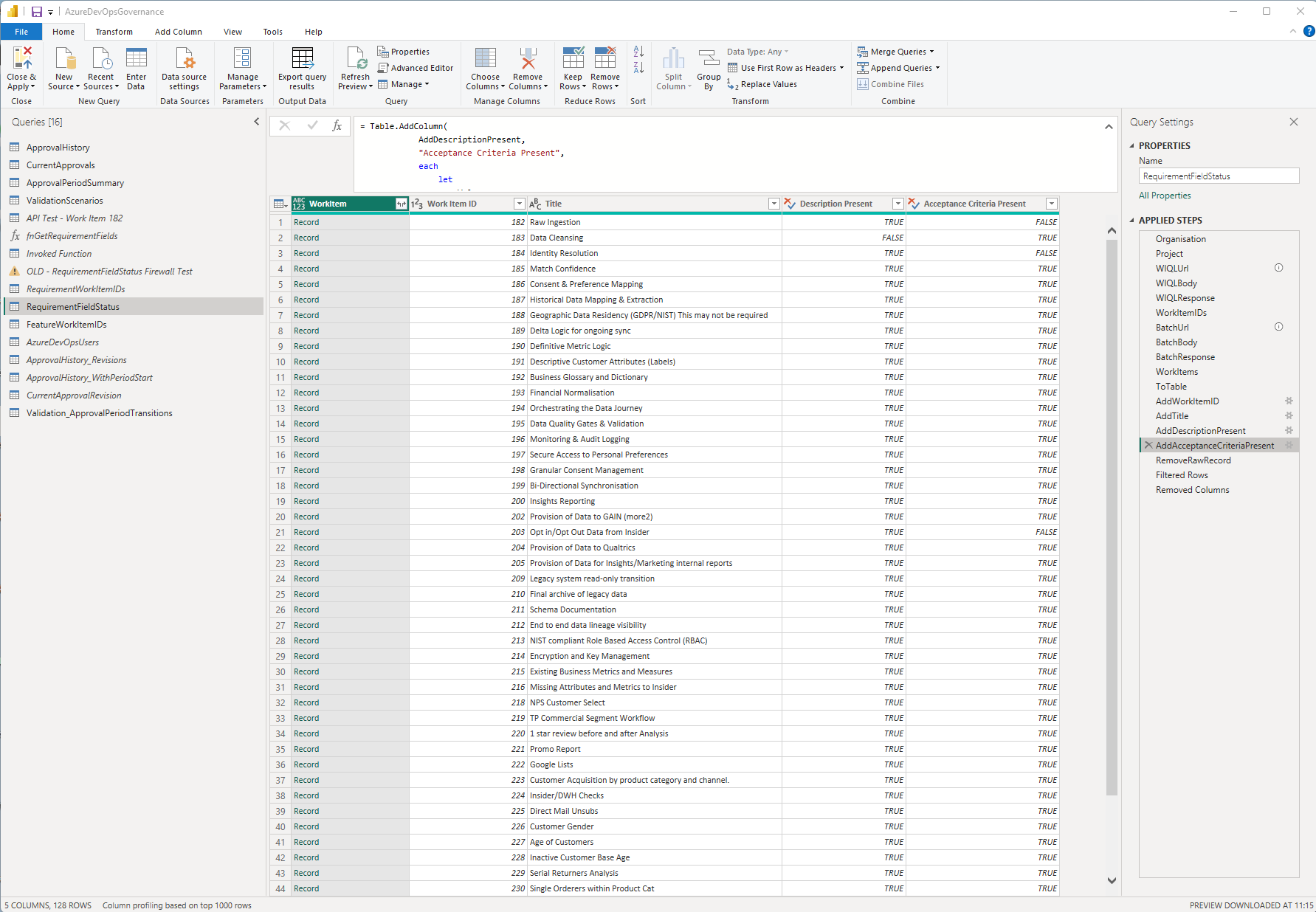
Power Query implementation showing representative transformation queries used to prepare Azure DevOps data for the analytical model.
What this demonstrates:
The Power Query layer performs business-rule-driven preparation rather than acting only as a source-loading mechanism. Historical and current-state data are deliberately separated, derived analytical fields are created and only the source information required by the reporting model is retained.
Transformation Design Evidence
| Source Requirement | Power Query Response | Analytical Result |
|---|---|---|
| Historical approval states required | Retain dated Analytics View snapshots | ApprovalHistory |
| Current reporting requires one row per User Story | Select and prepare deterministic current state | CurrentApprovals |
| Current continuous approval period required | Evaluate historical approval state and derive period start | Approval-period analysis |
| One responsible authoriser required | Apply Senior Authorised By / Authorised By precedence | Responsible Authoriser |
| Description completeness required | Retrieve current content and derive presence indicator | Requirements-health input |
| Acceptance Criteria completeness required | Retrieve current content and derive presence indicator | Requirements-health input |
| Parent must be a valid Feature | Prepare current Feature identifiers for comparison | Feature-parent validation |
| Multiple health issues can apply to one requirement | Retain issue-level analytical reasons | Requirements-health reason analysis |
What this demonstrates:
Each transformation exists to satisfy a defined analytical or business-rule requirement. The preparation layer provides a controlled bridge between the structure of Azure DevOps and the structure required by the Power BI semantic model.
Data-Minimisation Example
A specific design choice was made for long-text requirement fields.
The analytical model needs to know whether Description and Acceptance Criteria are complete, but it does not need to expose or analyse the underlying text.
The preparation process therefore retains the analytical result rather than the complete source text.
Source content
Description / Acceptance Criteria
↓
Power Query assessment
Present / Missing
↓
Semantic-model indicator
TRUE / FALSE
What this demonstrates:
The transformation design considers model efficiency and privacy as well as functional reporting requirements. Source data is retained only where it contributes to the analytical purpose.
Evidence Presented
The public case study presents selected evidence of:
- Azure DevOps source-data preparation;
- historical and current-state transformation design;
- approval-period reconstruction;
- responsible-authoriser derivation;
- WIQL and REST API enrichment;
- requirements-completeness indicators;
- Feature-parent validation;
- derived analytical fields;
- data-minimisation decisions; and
- transformation validation.
Only representative implementation evidence is published. Working Power Query logic, source configuration and implementation artefacts remain within the controlled project environment.
← Solution Architecture · Project Overview · Semantic Model →
© 2026 Carl Patten. All rights reserved.